
House Demolition in Newcastle and the Hunter
Clearing an older house so you can build again? We take down fibro, weatherboard and brick homes across Newcastle and the Lower Hunter. Services are disconnected, asbestos is dealt with first under NSW rules, and the house comes down in a set order so your builder walks onto a clear, level block.
- Asbestos taken out by SafeWork NSW licensed removalists
- Hazardous materials survey on older homes
- Services disconnection confirmed before work starts
- Clearance certificate before demolition resumes
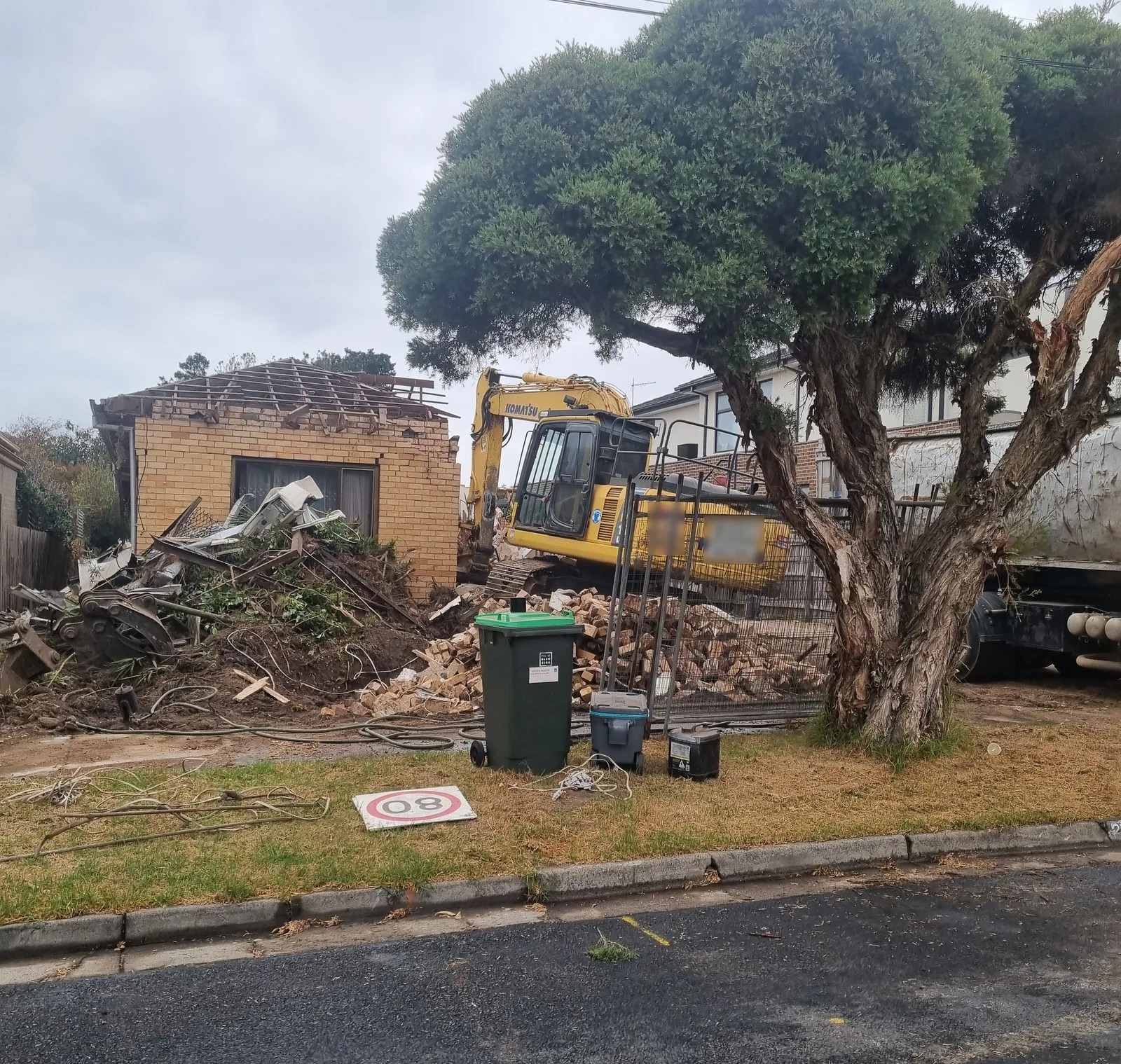
Knocking down to build again in the Hunter
Most houses we pull down around Newcastle are making room for a new home on the same block. The owner has usually picked a builder, signed a contract and has a start date pencilled in. Demolition sits right at the front of that program, so the order of work and the handover matter as much as the machine on site.
Before we price anything, we ask what the builder wants at handover. Some want every footing and pier gone and the block scraped level. Others want a tree kept, a driveway crossover left in place or a fence line held for the neighbours. Getting that clear early saves a second visit later.
The houses that come down around here
The Hunter has a lot of housing that has done its job. You see post-war fibro cottages on low stumps in Wallsend, Cardiff and Belmont, weatherboard workers' cottages around Mayfield and Hamilton, and brick veneer homes across Charlestown, Rutherford and Raymond Terrace. Out at Cessnock and Kurri Kurri there are old coalfield cottages on wide lots.
Each type comes down differently. A weatherboard cottage on timber stumps is mostly hand and machine work on the frame, then the stumps. A brick veneer home has a lot more masonry to sort. A fibro house needs the asbestos dealt with properly before the rest of it is touched.
Approvals: CDC or DA
In NSW, demolition goes through one of two paths. Many jobs qualify as Complying Development, which means a CDC issued by a registered certifier or by council, following the Exempt and Complying Development Codes SEPP. Other jobs need a Development Application lodged with council.
Heritage items, and many homes inside heritage conservation areas, are usually pushed to a DA. That is common in inner Newcastle, so if your place is in Cooks Hill, The Hill or Newcastle East, expect the approval path to take more planning. We work from your approval conditions, so have a copy ready when we talk.
Mine subsidence and the new build
Large parts of Newcastle and Lake Macquarie sit inside Mine Subsidence Districts. Building work in those districts, including the new home in a knockdown rebuild, needs approval from Subsidence Advisory NSW. Your builder or designer normally handles that application.
It does not change how the old house comes down, but it can affect when the new one can start. We like to know where that approval is at, so the block is cleared close to the builder's start rather than sitting empty for weeks.
Disconnections before anything moves
Nothing gets pulled down until the services are sorted. In the Hunter, that means Ausgrid for electricity, Hunter Water for water and sewer, Jemena for gas where the house is connected, and the telecommunications provider for the phone and internet lines. A Before You Dig Australia (BYDA) enquiry goes in ahead of any digging, such as pulling footings or old pipes.
We give you a plain list of what needs to be disconnected and who to contact, and we check each one is done before work starts.
Asbestos first, then the house
A house finished before 1990 may well have asbestos somewhere in it, and plenty of Hunter houses are older than that. A hazardous materials survey ahead of demolition tells us what is there and where. Fibro walls, eaves linings, wet-area sheeting, vinyl floor backing and old roofing are the usual finds.
NSW law says a SafeWork NSW licensed removalist has to do the job once there is over 10 square metres of non-friable material, and any friable asbestos is Class A licence work only. On our jobs, the asbestos is taken out by removalists who hold a SafeWork NSW licence, SafeWork NSW gets advance notice, and a clearance certificate has to be in hand before the rest of the demolition goes ahead.
How the demolition runs on site
Once the clearance is in hand, the job follows a set order:
- Site set up with fencing and any protection for neighbouring fences, driveways or trees
- Internal fittings and soft materials stripped out and sorted
- Roof, frame and walls taken down in a controlled sequence
- Brick, concrete, timber and steel separated for recycling where a facility will take them
- Slab, footings, piers and stumps removed as agreed with your builder
- Block levelled and left tidy for handover
Narrow streets in older suburbs can limit truck size and parking, so we look at access on the first visit and plan bin and truck movements around it.
Handing the block to your builder
At handover your builder should find a clear site, the agreed items left in place, and the documents they asked for, such as the asbestos clearance certificate. If anything turns up in the ground, such as old footings or buried rubble, we raise it with you before going further.
Pricing your demolition
Use the form on this page to send the address, some photos taken from the street and the back yard, and a note on what you plan to build. If you have your CDC or DA conditions, or a hazardous materials survey, include those too. We will look at access, asbestos and the approval path, then put a written quote together for you.
Why choose us for house demolition
- Work planned back from your builder's start date
- Hazardous materials survey before demolition of older homes
- Asbestos taken out by SafeWork NSW licensed removalists before the house comes down
- Ausgrid, Hunter Water, Jemena and telco disconnections checked first
- Brick, concrete, timber and steel separated for recycling where possible
- Slab, footings and stumps removed to the handover your builder asks for
House Demolition: common questions
Will the slab and footings go too, or just the house?
In most knockdown rebuilds, all of it goes: slab, footings, piers and stumps, and we agree the exact handover with your builder before work starts. Some builders want a driveway or a retaining wall left in place, and we work to that.
Does the asbestos have to come off before the house is demolished?
Yes. Any asbestos found in the hazardous materials survey is taken off first by a removal crew licensed by SafeWork NSW. SafeWork NSW gets advance notice, and a clearance certificate has to be in hand before the main demolition goes ahead.
My block is in a Mine Subsidence District. What changes?
The demolition itself runs the same way. The new home needs approval from Subsidence Advisory NSW, which your builder or designer usually applies for. We like to know where that approval sits so the block is cleared close to the build start.
Can you work in a narrow street with no side access?
Usually, yes. Older suburbs like Hamilton, Mayfield and Wickham have tight streets and small lots. We check access on the first visit and plan truck sizes, bin placement and parking around what the street allows.
Got an old Hunter house that needs to come down?
Put the address and a handful of photos into the quote form. We will check access, asbestos and the approval path, then send back a written quote.